
Tank Pickling, Passivation & Degreasing
Weld heat tint and iron taken off stainless steel (SS) tanks; oil, mill scale and rust off carbon steel (CS) tanks. From 50 litres to 300 KL.
Why it is needed
Why Stainless Steel Tanks Are Pickled and Passivated
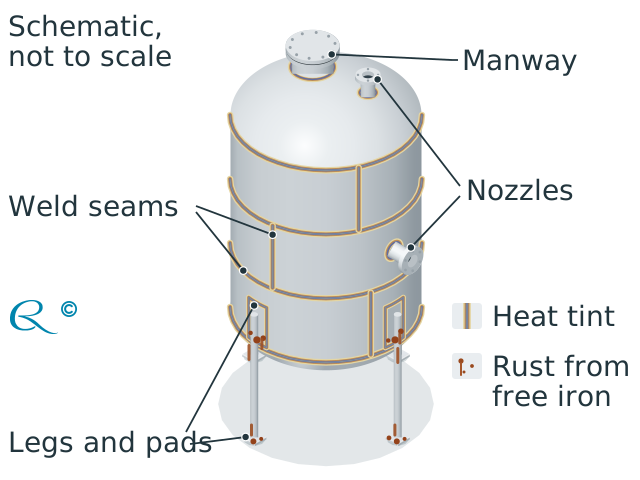
Stainless steel resists corrosion through a thin, chromium-rich passive film, and fabrication spoils it. Welding leaves heat tint, a coloured oxide from pale straw to dark blue with a chromium-depleted layer beneath it. Carbon steel tools, brushes and grinding dust leave free iron, which rusts. The workshop leaves oil, grease and marker ink, which acid alone cannot be relied on to remove.
It shows as rust spots on a new tank, dark weld lines, or water that beads instead of sheeting off.
On Stainless Steel: Three Treatments, Three Jobs
| Treatment | What it removes, and when |
|---|---|
| Degreasing | Oil, grease, cutting fluid, marker ink and other organic soil. Always, and always first. |
| Pickling | Heat tint, scale and the chromium-depleted layer beneath them, with a thin layer of the metal. Only where heat tint or scale is present. |
| Passivation | Free iron and other surface contamination, without etching the steel when the bath is clean and controlled. On every treated surface, after degreasing and any pickling. |
How We Treat the Inside of a Stainless Steel Tank
Survey and Data Sheet
With your engineer we record each tank’s capacity, grade, finish, product contact, fittings such as agitators, coils and baffles, and scope; the route and method are fixed from this signed sheet.
Preparation
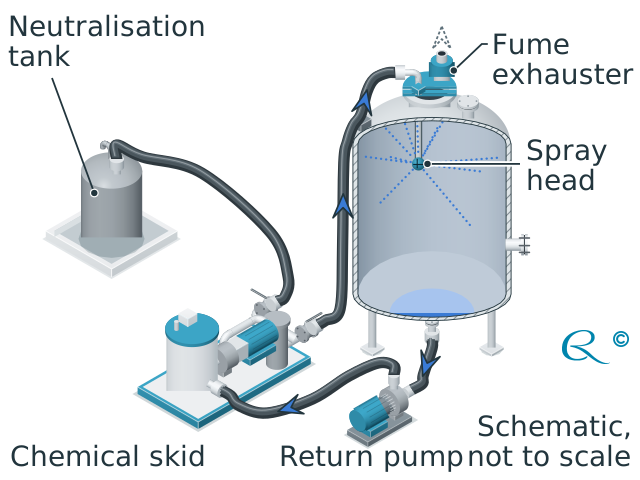
Under your permit and lock-out, instruments, gaskets and non-stainless parts come out, nozzles are blinded except the return, the spray head goes in through the top manway, which stays open with a fume exhauster on it, so the tank can breathe, and the circuit is leak-tested with DM (demineralised) water.
Degreasing
A warm, chloride-free alkaline degreaser is circulated and rinsed off, then the water-break check.
Pickling, Only Where Needed
Where a tank has heat tint or scale, a nitric-hydrofluoric solution is circulated, or gel is put on the welds alone, for the shortest time that clears it, then rinsed off with DM water. A circulated solution pickles the whole inside and leaves an even matt finish.
Passivation
Citric or nitric acid, as the tank’s route sets, takes off free iron so the chromium-rich film can form.
Final Rinse
DM water until the outlet matches the DM water going in: conductivity no more than 5 µS/cm above it, with the pH checked against it.
Dry, Test and Close
Drained, blown dry with oil-free air or nitrogen, tested, closed with cleaned gaskets, capped and tagged.
How We Treat the Outside of a Stainless Steel Tank
Inside and outside are scoped separately. Heat tint sits along the welds and around the nozzles and manway; rust from free iron often starts at the leg pads, or where the tank stood on carbon steel.
Outside, we work panel by panel from the top down, from a tagged scaffold or lift, with insulation, nameplates and instruments masked: low-pressure spray and soft brushes to degrease, gel on heat-tinted welds only where you approve, then citric acid, or nitric where approved, kept wet for its contact time, DM water rinses and a ferroxyl test with your engineer.
No panel dries with chemical on it, and work stops in rain or strong wind, or on a surface hotter than 40 °C.
Chemistry by Tank
The route is fixed for each tank once its material and grade (SS 304, 316 or 316L, or carbon steel), finish and your specification are known; a stricter specification applies. On stainless steel only chloride-free chemicals and DM water are used, because chlorides cause pitting and stress corrosion cracking: no hydrochloric acid, and no carbon steel tools or brushes.
| Tank | Route in our written method, and why |
|---|---|
| Stainless steel, product contact: pharma, API, purified water and WFI | Degreasing, rinse, citric acid passivation (4-10 % by weight, a citric treatment of ASTM A967), DM water rinse. No hydrofluoric acid is circulated in the tank, so the polished finish is not etched and the effluent is easier to treat. If a weld shows heat tint, it is pickled locally with nitric-hydrofluoric gel only after your written approval, and the gel is rinsed off with DM water before passivation. |
| Stainless steel utility and storage tanks, and outside shells | Degreasing, rinse, nitric-hydrofluoric pickling where heat tint or scale is present, rinse, nitric or citric acid passivation (a treatment of ASTM A967), DM water rinse. Passivation alone does not remove heat tint or scale, so they are pickled off first. |
| Electropolished stainless steel | Never pickled: pickling removes metal and would spoil the finish. |
| Carbon steel tanks | Degreasing, rinse, inhibited acid pickling of mill scale and rust, rinse and neutralisation, nitrite-based passivation against flash rust, final rinse, drying. This is the route in our carbon steel quotations, set out below. |
On stainless steel, bath strength is titrated before each stage, and logged with the temperature every 15 minutes during passivation.
Carbon Steel Tanks: Degreasing, Pickling and Passivation
Carbon steel (CS) tanks are cleaned for other reasons. Even a new tank usually carries mill scale, rust, weld scale and spatter, and anti-rust oil from the mill or the workshop; a tank in service adds oil and rust of its own. These come off to leave clean, bare steel for the tank’s service or its next coating.
In our quotations for carbon steel tanks the written method is: alkaline degreasing, hot where needed, and a rinse; pickling with an inhibited acid suited to carbon steel, which dissolves rust and mill scale while the inhibitor limits attack on the steel; rinsing and neutralising; a nitrite-based passivation; a final rinse; then drying with dry, oil-free air or nitrogen. Each solution is circulated in a closed loop. The work covers the inside; a painted outside is masked and protected.
On carbon steel, ‘passivation’ is not the chromium-rich passive film of stainless steel, which carbon steel cannot form. It is a corrosion-inhibiting treatment that holds off flash rust on the freshly pickled steel for a limited time, until the tank is painted or lined, oiled, filled or preserved. In our quotations the openings are capped as soon as the tank is accepted, and a tank that will stand idle for long can be kept under a slight nitrogen pressure.
Tanks for oxygen service also need an oxygen-clean finish; that work has its own page.
Method by Tank Size
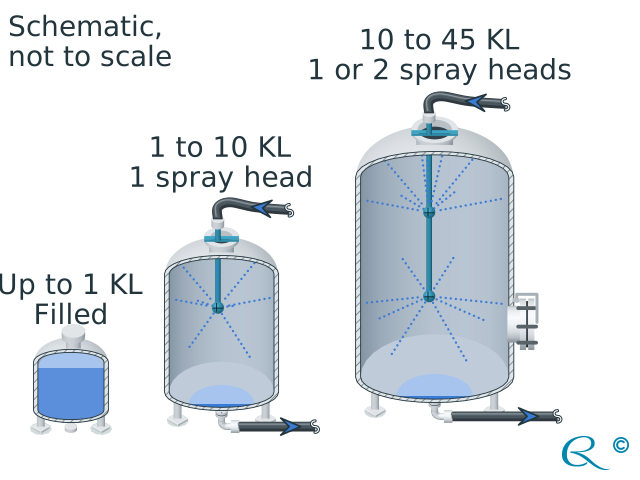
We take on stainless steel and carbon steel tanks and vessels of 50 litres to 300 KL. Small tanks are filled with each solution; larger ones get a rotating spray head, which wets the whole inside with a fraction of the volume, so far less chemical and effluent.
Up to 45 KL, our written method for stainless steel tanks sets the treatment by size, as below. For a larger tank, and for a carbon steel tank of any size, the number of spray heads, the volume per stage and the tank entry are fixed for each tank at the survey and set out in the written offer. In our quotation for four 300 m³ vessels, for example, about 12 m³ of solution is pumped from a tank outside each vessel through spray heads and back.
Size Bands for Stainless Steel Tanks in Our Written Method
| Tank size | How the inside is treated and inspected |
|---|---|
| 50 litres to 1 KL | Filled and soaked with the full volume, or circulated from a portable bath; identical tanks are treated in groups and rolled where practical, so every surface stays wet. Inspected from the opening with a torch and mirror or a borescope; nobody enters. |
| 1 to 10 KL | Closed-loop circulation through one rotating spray head at the top opening, with about 10-15 % of the tank volume per stage. Inspected from the manway; entry only where the manway allows it, under a confined-space permit. |
| 10 to 45 KL | Closed-loop circulation through one or two rotating spray heads (the second for tall tanks or heavy internals), with about 5-10 % of the tank volume per stage. Entry under the confined-space procedure, for inspection and the tests. |
One batch log covers a group of identical small tanks, with each tank’s tag listed.
Tests and Acceptance
On stainless steel, our checks follow ASTM A380, the standard practice for cleaning, descaling, pickling and passivation of stainless steel, and the tests of ASTM A967, the passivation specification, or your stricter specification. Staining tests are made on coupons or agreed areas, passivated again afterwards.
| Check | What it shows, and the pass |
|---|---|
| Water-break test (ASTM F22) | Oil or another water-repelling film left after degreasing: water breaks up or beads instead of spreading evenly. Pass: an unbroken film for the time set in the agreed procedure, on every tank. |
| Ferroxyl test for free iron (ASTM A380) | Free iron, as a blue colour within about 15 seconds. Pass: no blue within 15 seconds, on the welds and at least 3 other areas of each tank. The reagent contains a cyanide compound, so it is done by trained staff and washed off at once; on food, beverage or pharma product-contact surfaces only where every trace can be removed and you approve, otherwise on a coupon. |
| Copper sulphate test (ASTM A967, Practice D) | Free iron, where copper plates out on the steel. Pass: no copper deposit, on a coupon or an agreed area; never on a food or product-contact surface. |
| Final rinse | That acid and cleaner residues are rinsed out. Pass: at the outlet, conductivity no more than 5 µS/cm above the DM water going in, with the pH checked against it and logged, on every tank. |
| Visual inspection | Heat tint, stains, scale or residue left on the steel. Pass: a uniform surface with none of them, under white light and a torch, on every treated surface. |
Other ASTM A967 practices, such as the high-humidity test (Practice B), can be agreed instead of a staining test.
Checks on a Carbon Steel Tank
From our carbon steel quotations; the offer for each tank gives its passes. The ferroxyl and copper sulphate tests are for stainless steel only: they look for free iron, and carbon steel is iron.
| Check | What it shows, and the pass |
|---|---|
| Water-break test (ASTM F22) | Oil left after degreasing. Pass: water spreads in an unbroken film instead of beading. |
| Pickling end-point | That the rust and mill scale are off. Pass: the iron dissolved in the acid holds steady over three hourly readings, and no rust or mill scale is visible. |
| Rinse before passivation | That no acid is left. Pass: the rinse is at pH 6 or above before the nitrite passivator goes in, because nitrite that meets acid gives off toxic nitrogen oxides. |
| Final rinse and drying | That rinse residues are out and the tank is dry, so it does not rust again before it is closed. Pass: rinse outlet conductivity close to that of the water going in, no free water, and the outlet air’s dew point within the limit the offer sets. |
| Visual inspection | Rust, mill scale, oil, slag or debris left, and any flash rust after drying. Pass: clean, uniform bare steel under bright light. |
Case study
Degreasing, Pickling and Passivation for Tank Manufacturers, Up to a Tank of 300 KL
The situation. A new tank carries what fabrication leaves on it: workshop oil, weld scale or heat tint, and rust or free iron. So tank manufacturers have their tanks degreased, pickled and passivated before delivery. Among the tanks in this work was one of 300 KL (300 m3), the largest size we take on.
What we did. We carried out the degreasing, pickling and passivation for the tank manufacturers: degreasing first, pickling where there was heat tint or scale, and passivation last. How a tank of 300 KL is treated is fixed at a survey of that tank, since its spray heads, the volume of each solution and the way in are set tank by tank.
The result. The tanks were degreased, pickled and passivated, the largest of them 300 KL (300 m3), the top of the range we take on, which runs from 50 litres. We have no place, year or test result on file for this work, so none is stated here.
Where: Tank manufacturers’ works.
Records and Handover
In our written method every stage is recorded in ink as it is done, signed by our supervisor and countersigned by your engineer.
- Before work: SOP, method statement, HIRA and JSA for your approval; certificate of analysis and safety data sheet for every chemical batch; calibration certificates.
- Holds and witnesses: the joint inspection before cleaning and the final tests are holds; your engineer witnesses the water-break check, final rinse and effluent neutralisation.
- Each tank and stage: a batch log of chemical, strength, temperature, time, rinse pH and conductivity.
- Handover: test reports with before and after photos, the neutralisation and waste records, a signed passivation certificate for each tank, and the job report.
Safety in Tank Entry and Chemical Work
Our written method runs the work under your permit-to-work; anyone on the job can stop it.
- Tank entry only after lock-out, under a confined-space permit, never with chemical in the circuit: the air tested at three levels, ventilated and retested, entry at 19.5 to 23.5 % oxygen with flammable gas below 10 % of its lower explosive limit and no hydrogen sulphide or carbon monoxide, continuous monitoring, and an attendant with breathing apparatus and a rescue tripod.
- Chemicals move by pump in closed lines, acid always into water, after a water pressure test of the circuit; the crew wears acid suits, face shields, gauntlets and acid-gas respirators.
- Pickling carbon steel gives off hydrogen, a flammable gas: the top vent stays open, a gas detector that responds to hydrogen watches the vent and manway, no flame or spark is allowed near the vents, and nobody enters until the tank is rinsed, ventilated and tested free of flammable gas.
- Hydrofluoric acid passes through the skin, and its burns can show hours later, so calcium gluconate gel is kept at the site and the crew is trained in HF first aid.
Spent Chemicals and Effluent
In our written method, spent degreaser, acid and rinse water go to a bunded neutralisation tank, never a drain. Fluoride from stainless steel pickling is settled out with lime, and the pH is checked every 10 minutes until it holds between 6.5 and 8.5, then logged.
Release to your effluent treatment plant is only with your approval; sludge goes through your authorised hazardous-waste route. India’s general standard for treated effluent is pH 5.5 to 9.0 (Environment (Protection) Rules, 1986), and your consent may be stricter; acid and alkali residues from metal surface treatment such as this are hazardous waste under Schedule I of the Hazardous and Other Wastes (Management and Transboundary Movement) Rules, 2016. Disposal through an authorised facility can be quoted separately.
Where It Is Used
- Pharmaceutical and biotech plants: process vessels, purified water and WFI tanks.
- Food, beverage and dairy plants: product-contact tanks.
- Chemical plants: storage tanks and reactors, including tanks for hydrogen peroxide.
- New stainless and carbon steel tanks: after fabrication, before they go into service.
- Any plant: tanks after repair or modification welding.
What Your Site Provides
Our written method puts these in the customer’s scope; your offer confirms them.
- Permits and gate passes, including confined space and work at height.
- Each tank drained, isolated and locked out.
- DM water, 415 V power and compressed air at the work location.
- A scaffold or boom lift for outside work, unless the offer says otherwise.
- Your effluent treatment plant, or an agreed route, for the neutralised effluent.
Tank Work on Our Records
In 2026 we cleaned the inside of a 40 KL gear oil tank at a wind turbine plant near Chennai, taking out sediment, carbon particles and moisture. The method in our quotation for it was alkaline degreasing of the stainless steel and DM water rinsing, under a confined-space permit, with no pickling or passivation. We have also done degreasing, pickling and passivation for tank manufacturers, up to a tank of 300 KL. With no invoice or job record behind it, that work appears only as the case study above and is not one of the jobs counted here. From our quotations: in 2026 we quoted pickling and passivation of four 5,000-litre stainless steel tanks, two smaller ones and their pipelines for hydrogen peroxide service at a plant in Pondicherry. In 2026 we also quoted degreasing, pickling and passivation of two 64 m³ carbon steel tanks and a 25 m³ one, with their piping, for oxygen service at a new plant in Gujarat.
Questions Buyers Ask
Does a new stainless steel tank need pickling, or only passivation?
Pickling is for heat tint and scale, mostly at the welds. A new tank whose welds show no heat tint is usually degreased and passivated only. The survey with your engineer decides it for each tank, and the method statement records the decision.
Will the treatment dull a polished or electropolished finish?
Pickling removes a thin layer of metal and can dull a bright finish, so electropolished surfaces are never pickled, and polished product-contact surfaces only with your written approval, usually at a weld alone. Correctly done passivation does not etch 304 or 316 stainless steel. ASME BPE treats a properly electropolished and rinsed surface as passivated; it normally needs passivating again only after welding, polishing or contamination.
Is the tank ready for product after passivation?
The final DM water rinse is checked at the outlet for pH and conductivity, and the tests and the certificate record it. The rinse or sanitisation before the first product belongs to your own cleaning and qualification procedure.
Can you treat a tank that has been in service?
Yes, we can quote for one once it is emptied, isolated and cleaned of its product, for example in a shutdown. It is surveyed first, because deposits and wear change the method. ASTM A380’s scope leaves out equipment already in service, so the work follows its principles and is not described as done to it.
How long will the tank be out of service?
It depends on the size and number of tanks, the route, and whether the outside is treated too. We state the days on site in the written offer, after the survey.
Does a carbon steel tank need painting or preserving afterwards?
Yes, and soon: on carbon steel, passivation is only a short-term guard against rust. Plan the next step, whether paint or a lining, oil, the product itself, or a closed and dry tank, as your plant’s procedure sets. We agree its timing with you before the work starts, and the written offer states it.
Do you also clean oxygen tanks, or oil tanks with sludge?
Yes, as two other services, both linked below. Tanks and vessels for oxygen service are cleaned free of oil and grease under gas line flushing and oxygen tank cleaning, and sludge, water and scale are removed from oil and fuel tanks under tank cleaning.
What is the price?
Prices depend on the number and size of the tanks, the route, inside or outside, and the access, so we quote for each enquiry.
Does your invoice show the HSN code?
Yes. Our GST invoice shows the HSN or SAC code for each line.
Related Services
Pipeline Pickling & Passivation
The same treatment for the pipework connected to your tanks, circulated through the installed lines.
Gas Line Flushing & Oxygen Tank Cleaning
Tanks and vessels for oxygen service cleaned free of oil and grease, and gas lines flushed.
Tank Cleaning
Sludge, water and scale taken out of oil, fuel and chemical storage tanks.
Degreasing of Pipelines
Oil, grease and cutting fluid cleaned out of new and installed pipework before pickling, flushing or start-up; cleaning for oxygen service is a separate service.
Pipeline Flushing
Hydraulic and lube oil lines flushed clean before start-up.
Chemical Cleaning of Pipelines
Scale and deposits dissolved out of lines that have been in service.
Ask About Tank Pickling, Passivation and Degreasing
Tell us about the job. “Not sure” is a fine answer; we will ask follow-up questions.
Request received. Your reference is {ref}. We reply during office hours, Monday to Saturday, 9.00 am to 5.30 pm. For a breakdown or a plant shutdown, call +91 99400 49505 at any time. Nothing is booked or ordered until we confirm scope, availability and terms in writing.Prefer to talk? Call +91 99400 49505 or WhatsApp us.

Book a Tank Survey
Our team can come to your site to survey the tanks with your engineer: size, grade, finish, welds and fittings.
Request an Assessment
Get Expert Advice for Your Tank Passivation
Call or WhatsApp an engineer, or send the tank material, capacity and finish, with photos of the welds. We reply with the route we propose.
WhatsApp +91 99400 49505