
Flanges for Hydraulic and Process Pipework
Ram Engineering, based in Chennai, is a pipe flange and hydraulic flange supplier in India: pipe flanges in carbon steel and stainless steel, and four-bolt split flanges.
What to Send for a Quote
If you know the flange, this is enough to start:
- Pipe flanges: type and face (weld neck, slip-on, socket weld, threaded, lap joint or blind; raised face, flat face or ring joint), and the size, standard and class (or PN) from your drawing; for weld neck and socket weld flanges, the pipe’s wall or schedule too.
- Split flanges: the series your pump or drawing calls for (standard or high pressure), the port size, and inch or metric bolts.
- Material: carbon steel or the stainless grade.
- No drawing? A photo of the old flange’s marking, or of the port and flange head. Send photos on WhatsApp to +91 99400 49505 or by email to [email protected].
- Quantity and date, and whether you need gaskets or O-rings too.
What a Flange Does
A pipe flange joins a pipe to another pipe, a valve, a pump or a vessel with bolts and a gasket, so the joint can be opened again for maintenance. A hydraulic split flange does the same for a hose or tube at a pump, motor or valve port, and seals with an O-ring.
Two pipe flanges bolted together must match: the same standard, size, class and face, with a gasket that suits both. Flanges made to different standards can look alike and still differ in the bolt circle, the number of bolts or the thickness.
Before you open a joint or measure pipework in place, isolate the line, release the pressure, drain it and let it cool, and follow your plant’s safety procedure.
We are a supplier, not the maker.
Pipe Flange Types
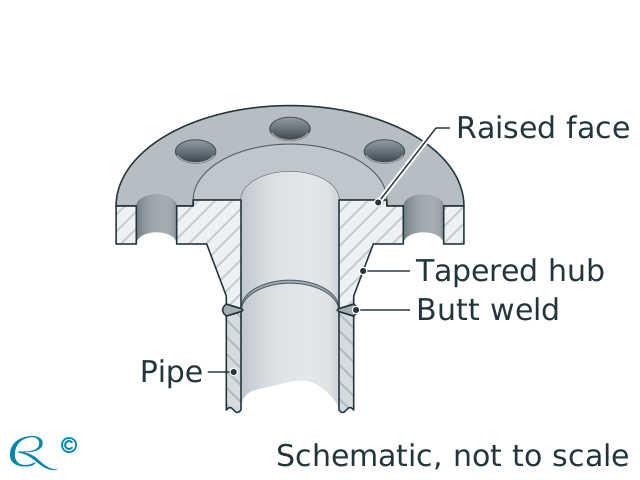
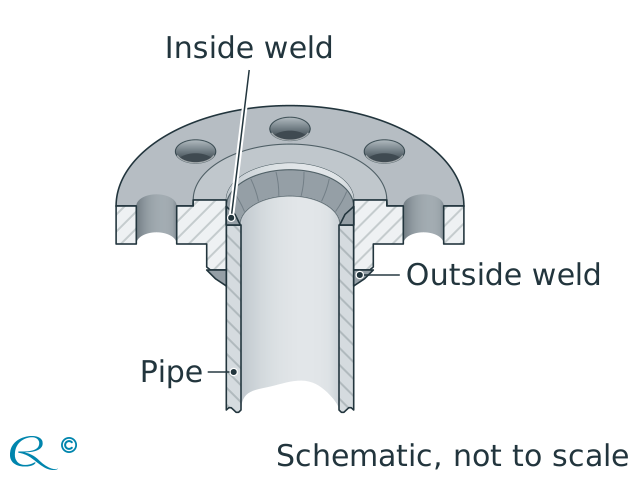
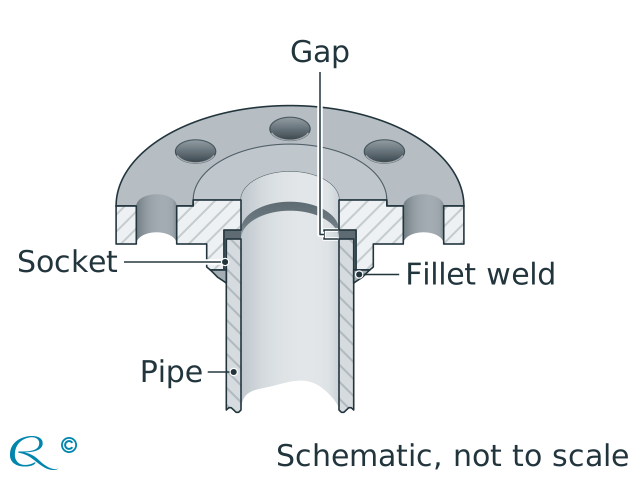
Tell us which type your drawing or the old flange shows. Each drawing is a half section above the centre line, taken through a bolt hole; all are schematic, not to scale.
Weld Neck
A long tapered hub is butt-welded to the pipe and carries the load smoothly into it, and the bore is machined to match the pipe’s bore. Often used on high-pressure and high-temperature lines, and on lines with cyclic loads.
Tell us: the size, standard, class and face, and the pipe’s wall or schedule.
Slip-on
Slides over the pipe and is fillet welded inside and outside. Simpler to fit and align than a weld neck; generally used for lower pressures and temperatures, where the line’s specification allows it.
Tell us: the size, standard, class and face, and the pipe’s outside diameter.
Socket Weld
The pipe sits in a socket bored in the flange and is fillet welded outside. Before welding, the pipe is usually drawn back to leave a gap of about 1.5 mm (1/16 inch) at the bottom of the socket, so the weld is not cracked as the pipe expands; follow the line’s piping code and welding procedure. Used on small-bore lines.
Tell us: the size, standard and class, and the pipe’s schedule, which sets the bore beyond the socket.
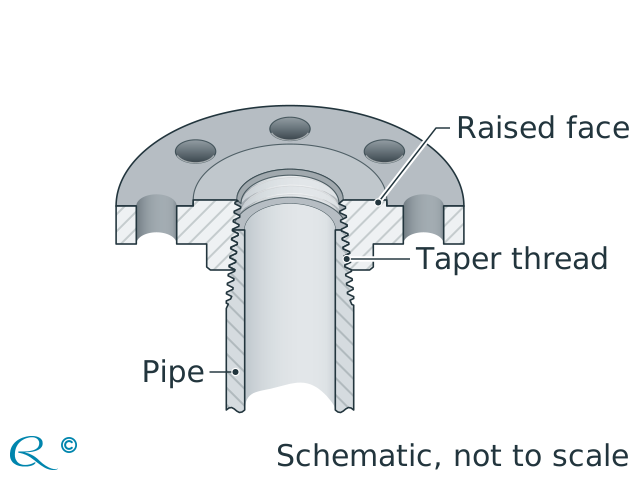
Threaded
Screwed onto a pipe with a taper thread, with no welding, for small lines where welding is not allowed or not practical. Generally avoided where the line sees high temperatures, heavy vibration or bending loads, which can loosen or crack a threaded joint.
Tell us: the size, standard and class, and the thread on the pipe, such as NPT or BSPT.
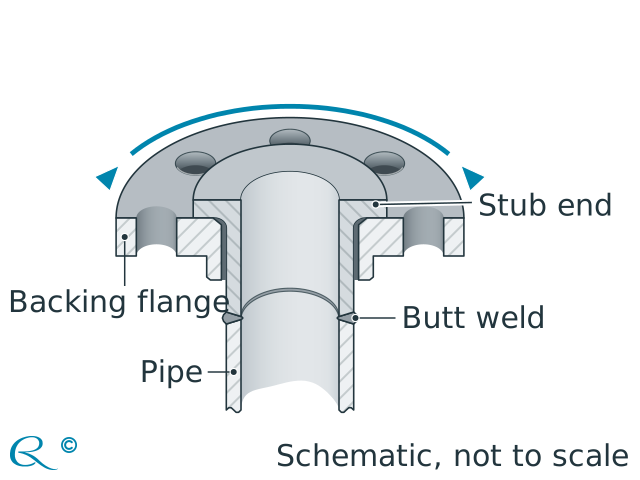
Lap Joint
A loose backing flange turns on a stub end welded to the pipe, so the bolt holes line up easily. The stub end, which the fluid touches, can be stainless steel while the backing flange is carbon steel, where the line’s specification allows.
Tell us: the size, standard and class, and the materials of the stub end and the backing flange.
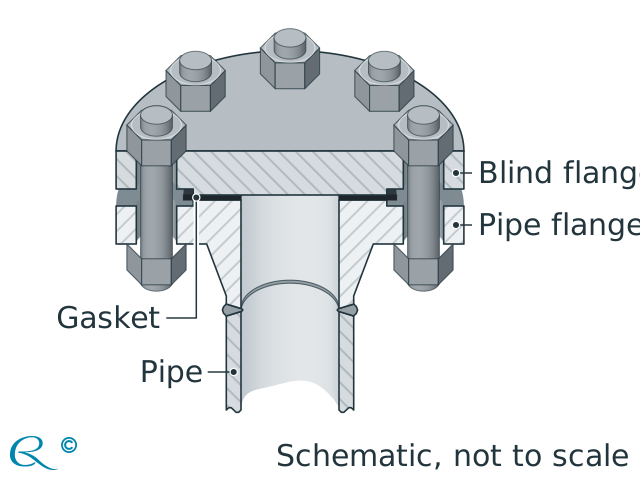
Blind
A solid plate with bolt holes that closes the end of a line, a valve or a vessel nozzle. It bolts to a flange of the same standard, size, class and face, with a gasket between them.
Tell us: the size, standard, class and face, and the material.
Hydraulic Split Flanges for Pump and Valve Ports
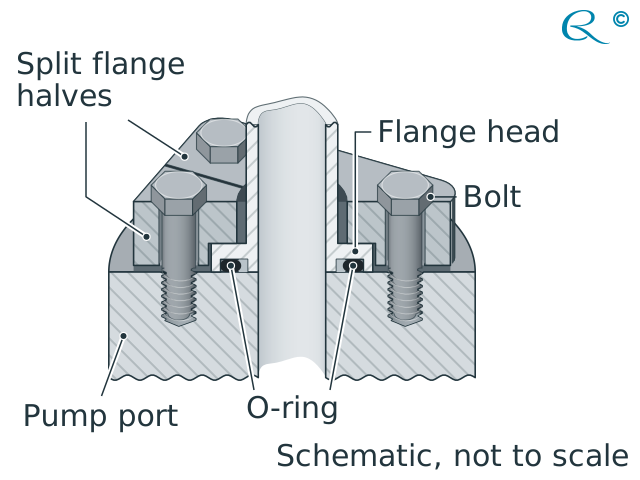
On hydraulic pumps, motors, valve blocks and cylinders, the larger ports are often four-bolt flange ports. The hose or tube end has a flange head with an O-ring in its face; two split flange halves, or a one-piece flange, fit behind the head, and four bolts pull it against the port face, where the O-ring seals.
Tell us whether your pump or your drawing calls for SAE code 61, the standard-pressure series, or code 62, the heavier high-pressure series, with the port size and whether the bolts are inch or metric.
The two series differ in their dimensions, so the halves, heads and bolts of one do not fit the other. Ask for new O-rings with them; an old one should not be refitted.
Isolate the machine and release the pressure before you inspect or measure a split flange. Before you open the line, lower or support any load it holds, let the oil cool and drain it, following the machine maker’s and the plant’s instructions.
How to Measure an Old Flange
With no drawing, measure the old flange, ideally once it is off. Before you open a joint or measure pipework in place, isolate the line, release the pressure, drain it and let it cool, and follow your plant’s safety procedure.
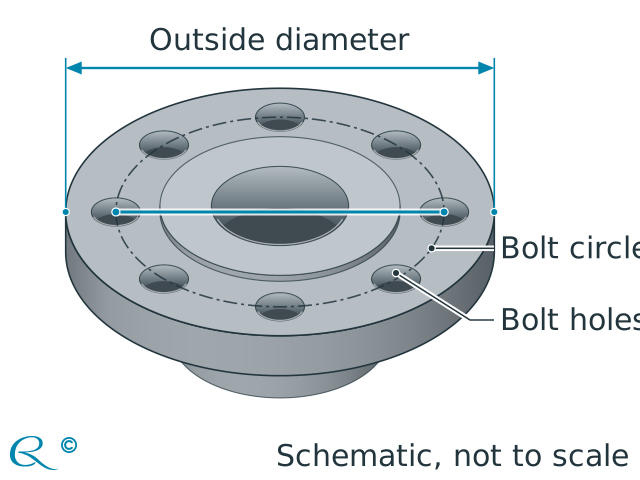
Outside Diameter
Across the flange, at its widest.
Bolt Circle
From the centre of one bolt hole to the centre of the hole directly opposite. If those two holes are the same size, measuring from the left edge of one to the left edge of the other gives the same distance. With no hole directly opposite, as with an odd number of holes, send the distance between the centres of two neighbouring holes and the number of holes, or a drawing.
Bolt Holes
Count them, and measure the diameter of one.
Thickness and Face
The thickness at the rim, and the diameter and height of the raised face, if there is one.
Bore and Marking
The bore, and a photo of the marking stamped on the rim, which often gives the size, the class, the material and the standard. Send photos on WhatsApp to +91 99400 49505 or by email to [email protected].
For a Split Flange Instead
The bolt-hole centre distances along both sides of the four-bolt pattern, the flange head’s diameter and thickness, and the bolt thread.
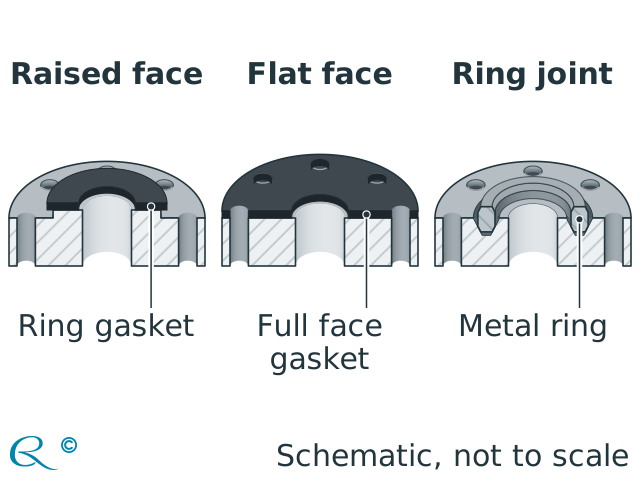
Pipe Flange Faces and Their Usual Gaskets
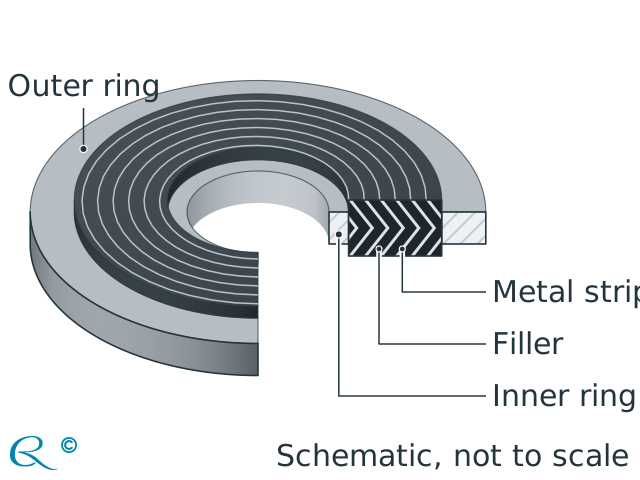
The face and the joint’s design set the gasket. In the usual arrangements, a raised face takes a ring gasket inside the bolts, or a spiral wound gasket; a flat face takes a full face gasket with the bolt holes in it, though some designs use a ring gasket; a ring joint face takes a solid metal ring seated in a groove.
Two flanges bolted together normally have the same face. A raised-face flange bolted to a flat-face flange of cast iron, as found on many pumps and valves, can crack it as the bolts are tightened; such joints need a flat-face flange and, usually, a full face gasket, as the equipment maker specifies.
Before We Select the Flanges
A pipe flange must suit the line, the flange it bolts to and the gasket between them; a split flange must suit the port, the flange head and its O-ring. What our quotation will confirm: the item we propose and its specification, what we matched it to, the quantity and availability.
| Detail | Why it matters |
|---|---|
| Pipe flanges: standard and class (or PN), from the drawing | They fix the bolt circle, the number and size of the bolts, and the thickness. |
| Pipe flanges: size, and the pipe’s outside diameter | Inch and metric pipe series differ in outside diameter at some sizes, and the flange must fit the pipe. |
| Pipe flanges: the pipe’s wall or schedule | For weld neck and socket weld flanges, the bore must match the pipe’s bore. |
| Pipe flanges: face of the mating flange | Raised face, flat face or ring joint: both flanges normally need the same face. |
| Split flanges: series, port size and bolt thread | Together they set the halves, the flange head, the bolts and the O-ring that fit the port. |
| Split flanges: the flange head | Welded to a tube, on a hose fitting or on an adaptor: say which, and whether you need heads too. |
| Fluid, and maximum and minimum temperatures | They decide the material: forged carbon steel for oil, steam and most process lines, stainless steel where the fluid or the site is corrosive, and a steel made for low temperatures in very cold service. |
| Design pressure, and surges | A pipe flange’s allowed pressure falls as its temperature rises, so the line’s design code sets the class; a split flange must match the series of the port it bolts to. |
| Gaskets, or O-rings and bolts for split flanges | Say if you need them, so that the joint is quoted as a set. |
| Quantity and required date | Lets us confirm availability and lead time with the quotation. |
Example
From Our Quotations
In 2025 we quoted 3 inch split flanges with O-rings, and a tee with a flange, for a pipeline job at an aluminium plant.
Questions Buyers Ask
What is the difference between a slip-on and a weld neck flange?
A slip-on flange slides over the pipe and is held by two fillet welds; it is simpler to align and fit. A weld neck flange is butt-welded to the pipe through its tapered hub, which spreads the stress and generally suits higher pressures and temperatures.
What is a blind flange used for?
To close a line, a valve or a nozzle that must be opened again later: for cleaning, inspection, a pressure test or a future connection. It is ordered like any other flange, by standard, size, class, face and material.
Why does a split flange leak at the port?
Often the O-ring: an old one refitted, the wrong size or material, or one pinched by bolts drawn up unevenly. A scored port face or flange head can leak too. With the machine isolated, the pressure released and the line drained, fit a new O-ring, check both faces, and tighten the bolts evenly, crosswise, to the torque the machine or flange maker specifies.
Can you match a flange from a photo?
Often. A photo of the marking on the rim and of the face, or of a split flange on its port, with the measurements listed above, is usually enough. Send photos on WhatsApp to +91 99400 49505 or by email to [email protected]. We confirm the standard and class, or the series and port size, with you before we quote.
Does your invoice show the HSN code?
Yes. Our GST invoice shows the HSN or SAC code for each line.
Can you supply the gaskets or O-rings as well?
Yes. Tell us the flange, the fluid and the temperature, and we quote a gasket to suit the joint, or the O-ring for a split flange.
Do you keep stock?
Availability is confirmed with each quotation.
What is the price?
Prices depend on the type, the size, the class, the material and the quantity, so we quote for each enquiry.
Where We Work
Tamil Nadu
Telangana
Kerala
Andhra Pradesh
Odisha
Delhi NCR
Rajasthan
Jharkhand
Uttar Pradesh
West Bengal
Punjab
Chhattisgarh
Send Your Flange Details
Pipe flange type, size, class and material, or the split flange series and port size, with the quantity. If you have a drawing, email it to us or send it on WhatsApp once the form is sent.
Request received. Your reference is {ref}. We reply during office hours, Monday to Saturday, 9.00 am to 5.30 pm. For a breakdown or a plant shutdown, call +91 99400 49505 at any time. Nothing is booked or ordered until we confirm scope, availability and terms in writing.Prefer to talk? Call +91 99400 49505 or WhatsApp us.
Related
Gaskets
Spiral wound, ring joint and sheet gaskets for each flange face.
O-Rings
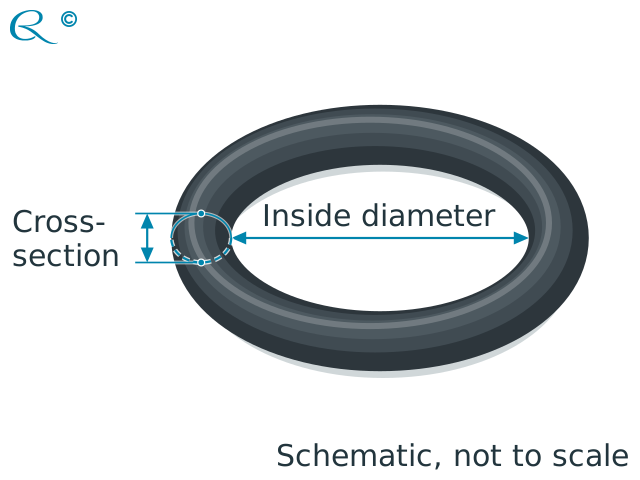
O-rings for split flange heads, fittings, valves and covers.
SS and CS Pipes
Pipe and tube in stainless or carbon steel, by NB or outside diameter.
Hydraulic Fittings
Hose ends, tube fittings and adaptors, matched to your thread form and size.
Pipeline Pickling & Passivation
Acid pickling to remove weld oxide and scale, then passivation to restore corrosion resistance, on installed piping.
Pipeline Flushing
Scope review for new or serviced hydraulic and lube oil systems.