Industrial Hose Clamps
Ram Engineering, based in Chennai, is a hose clamp supplier in India: worm-drive, T-bolt, spring, ear and wire clamps in zinc-plated and stainless steel.
What to Send for a Quote
These are enough to start a quote. Send photos on WhatsApp to +91 99400 49505 or by email to [email protected].
- The hose OD as fitted, measured where the clamp will sit on the spigot, or the hose bore and wall thickness.
- The clamp type and band width, or a photo of the old clamp on the hose.
- The material: zinc-plated or stainless steel, and the grade if you know it.
- What the hose carries, its temperature and its pressure.
- The quantity, and the date you need the clamps.
Where Hose Clamps Are Used, and Where They Are Not
A hose clamp squeezes a soft hose onto a barbed or plain spigot. It is the right fitting for low pressure lines: coolant and water hoses, air intake and charge air hoses, fuel return and drain lines, and suction hoses.
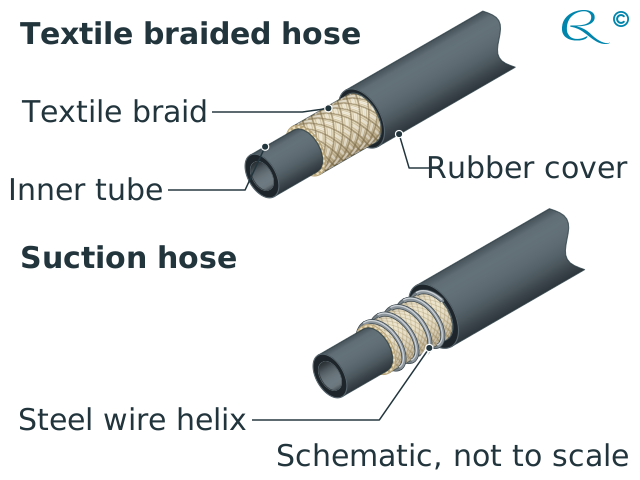
A hose clamp is not a substitute for a crimped fitting on a high pressure hydraulic hose. Those hoses need proper hose ends, because a clamp cannot hold oil at hydraulic pressure.
We also supply support clamps, a different part: they hold a hose or a steel tube to the machine frame so that it does not rub or vibrate, and they seal nothing.
Isolate the machine and release the pressure before you inspect or measure a hose joint. Before you loosen a clamp, let the line cool and drain it, following the equipment maker’s and the plant’s instructions.
We are a supplier, not the maker.
Hose Clamp Types
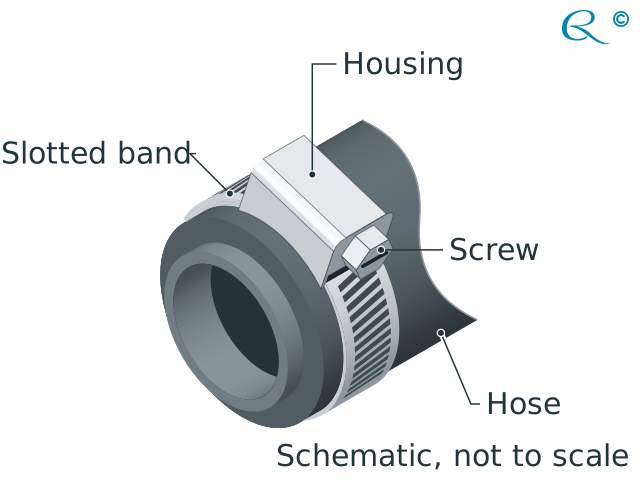
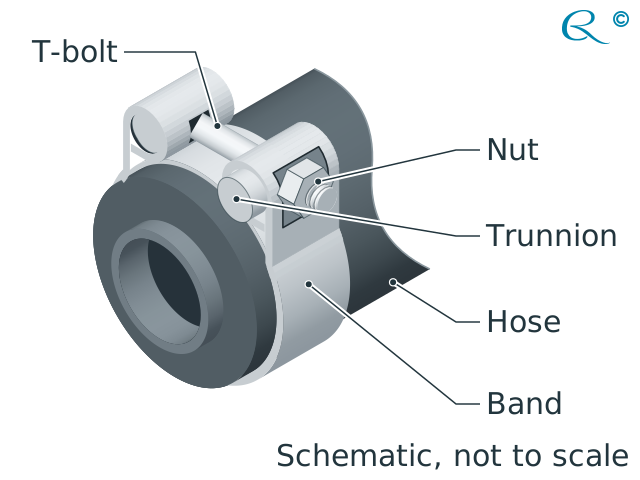
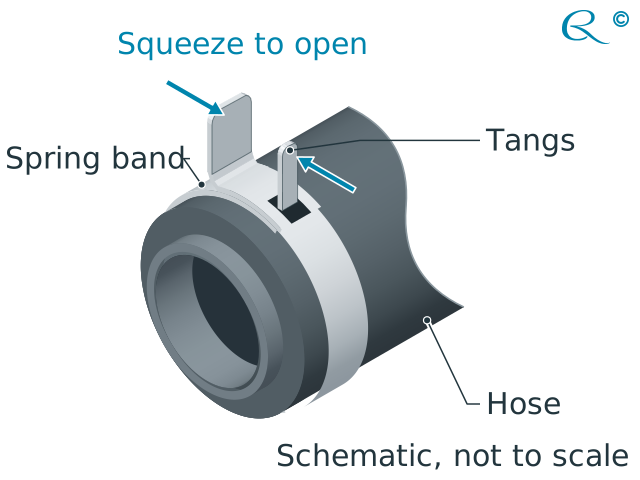
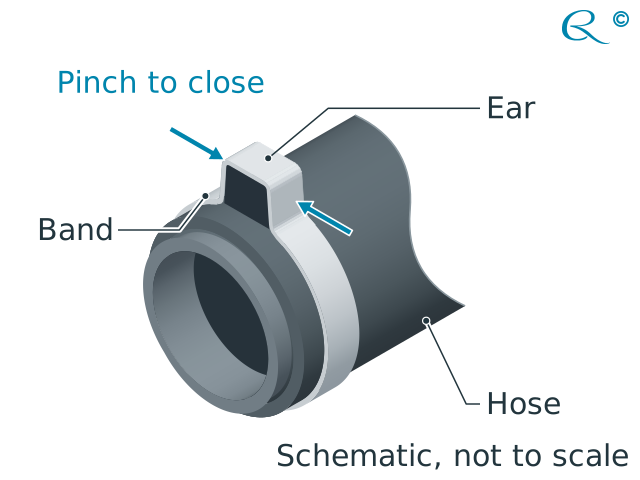
Drawn schematic and not to scale, in one common form of each type; the old clamp tells us which one you have.
Worm-Drive Clamps
A band with slots or pressed teeth, tightened by a screw in a housing and adjustable over a range of diameters: the common clamp for coolant, water, air and drain hoses. A band with pressed teeth and no slots is generally kinder to soft hoses such as silicone.
Tell us: the fitted hose OD, the band width, and the material of the band, housing and screw.
T-Bolt Clamps
A wider, heavier band pulled tight by a T-bolt and a nut for an even grip all round, over a narrow range of diameters. Used on large and thick-walled hoses, charge-air hoses and hoses that vibrate or pulse; some have a spring that keeps the load as the hose heats and cools.
Tell us: the fitted hose OD to the nearest millimetre, the band width and whether you need the spring.
Spring Clamps
A spring steel band that keeps its grip as the hose heats, cools and takes a set, opened with pliers on its tangs; each fits a small range of diameters. Used on engine cooling hoses and other joints that cycle in temperature.
Tell us: the fitted hose OD and the band width.
Ear Clamps
A band closed for good by pinching its ear with pincers: a neat joint that cannot be loosened by hand, for small hoses, fuel and air lines and push-on fittings. It is cut off to remove, and replaced each time.
Tell us: the fitted hose OD, the band width, and one ear or two.
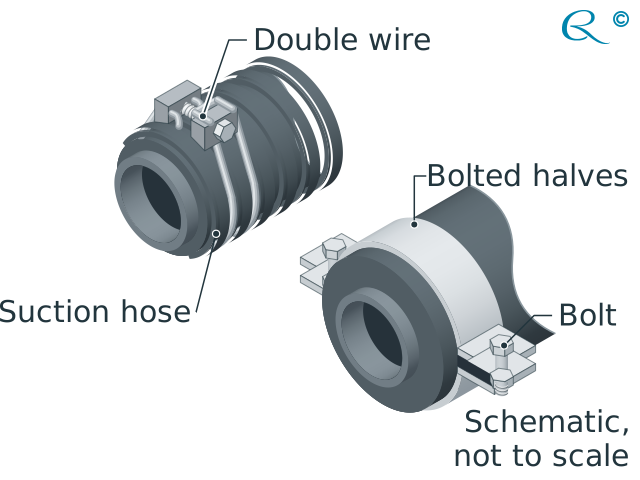
Wire and Bolted Clamps
Double-wire clamps, two loops of wire tightened by a screw, which can sit between the ribs of a suction hose; and two-piece clamps bolted together on large suction and delivery hoses. Used on transfer pump, tanker and slurry hoses.
Tell us: the hose type, its outside diameter and how many clamps the joint is specified to take.
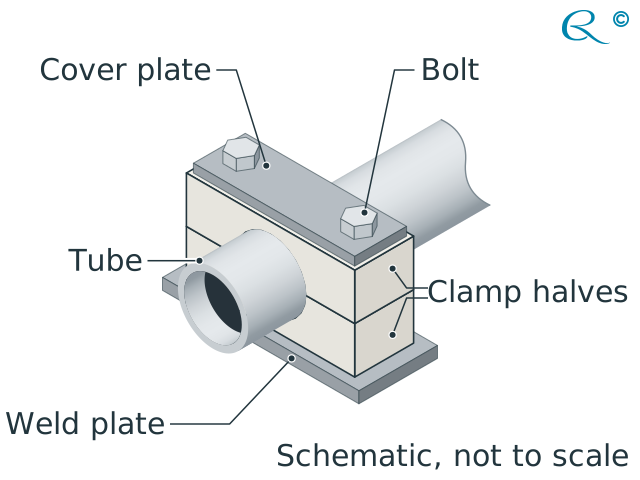
Support Clamps for Hoses and Tubes
Two-part clamp blocks, single or twin, closed by a cover plate and bolts on a weld plate or a rail, and rubber-lined P-clips. They hold hydraulic hoses and steel tubes to the frame and damp vibration; they do not seal a joint.
Tell us: the outside diameter of the tube or hose, and the clamp you need: a single or twin block on a weld plate or a rail, or a P-clip.
SS or Zinc-Plated Clamps
Catalogues often name the material by a grade from W1 to W5. Makers’ grades differ in detail, so tell us the material of the band, the housing and the screw.
| Material | Where it is used |
|---|---|
| Zinc-plated steel (often W1) | Dry, indoor places; it rusts where it stays wet. |
| Stainless band and housing, plated screw (often W2) | Damp places, at a lower cost than all-stainless; the screw can rust first. |
| All stainless steel (often W4) | Water, coolant, outdoor and washdown areas. |
| All 316 stainless steel (often W5) | Sea water, salt air and chloride cleaners. |
How to Size a Hose Clamp
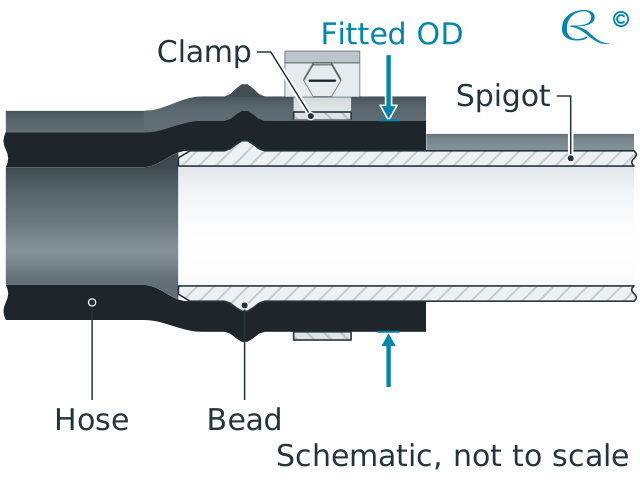
A clamp is sized by the range of diameters it closes over and the width of its band. Measure the hose’s outside diameter where the clamp will sit, once it is pushed onto the spigot: it stretches there, so it measures more than when loose.
Choose a clamp whose range has the fitted hose diameter near the middle, not at either end.
Fit the clamp where the hose, fitting or equipment instructions place it: usually over the spigot, between the bead (or the last barb) and the hose end, and never over the cut edge.
Before We Select a Clamp
A clamp must suit the hose, the spigot and its surroundings, not only the diameter. Send what you know.
| Detail | Why it matters |
|---|---|
| Fitted outside diameter of the hose | Sets the clamping range; measured on the spigot, as shown above. |
| Hose material and wall | Soft hoses such as silicone are better with a wide band without slots; a thick wall may need a T-bolt clamp. |
| Band width | A wider band spreads the grip; the length of the spigot can limit it. |
| Clamp type | Worm-drive, T-bolt, spring, ear, wire, bolted or support clamp. |
| Material of band, housing and screw | Zinc-plated or stainless steel, for the place it works in. |
| What the hose carries, its temperature and pressure | Hot and pulsing lines need a clamp that keeps its grip. |
| The joint’s instructions | The number of clamps, where they sit and the tightening torque set for that hose and spigot. |
| Room around the joint | The screw or bolt must be reachable to tighten, and to check later. |
| Quantity and required date | Lets us confirm availability and lead time. A less common item takes longer to deliver, and the quotation states the delivery time. |
What our quotation will confirm: the item we propose and its specification, what we matched it to, the quantity and availability.
Example
Recent Supply
In 2026 we supplied 8 mm stainless steel hose clips as part of a tools and consumables package for an aluminium plant.
Questions Buyers Ask
Can I use a hose clamp on a hydraulic pressure hose?
No. A hose clamp only holds low pressure. A hydraulic pressure hose needs crimped or reusable hose fittings, which we can also supply.
How tight should a worm-drive clamp be?
Tighten it to the installation torque, and in the way, set for that clamp and hose assembly by the clamp, hose or equipment instructions. Whether the hose can be turned on the spigot by hand is not a reliable test of the joint. Some instructions also ask for a check after the first run at working temperature, as rubber settles.
Can I reuse a hose clamp?
A worm-drive or T-bolt clamp can often be refitted if its band, housing and screw are undamaged and free of rust, and its maker allows reuse. An ear clamp is single-use. Replace a spring clamp that is damaged or has lost its tension.
Should I use two clamps on one joint?
Use the number and placement of clamps specified for that hose-tail assembly in the hose, fitting or equipment instructions. Tell us what they call for, and we quote for that.
Why does a clamped hose still leak?
Common causes are a clamp too large for the fitted diameter, a band sitting over the bead or the cut end, a hose that has hardened or taken a set, and a scored spigot. A new clamp will not cure a hardened hose. Replace a degraded hose; shorten and refit it only if the hose and equipment instructions permit this and enough sound length remains.
Do you keep stock?
Availability is confirmed with each quotation.
What is the price?
Prices depend on the clamp type, the size, the material and the quantity, so we quote for each enquiry.
Does your invoice show the HSN code?
Yes. Our GST invoice shows the HSN or SAC code for each line.
Where We Work
Tamil Nadu
Telangana
Kerala
Andhra Pradesh
Odisha
Delhi NCR
Rajasthan
Jharkhand
Uttar Pradesh
West Bengal
Punjab
Chhattisgarh
Send Your Clamp Details
Hose outside diameter, band width, clamp type, material and quantity.
Request received. Your reference is {ref}. We reply during office hours, Monday to Saturday, 9.00 am to 5.30 pm. For a breakdown or a plant shutdown, call +91 99400 49505 at any time. Nothing is booked or ordered until we confirm scope, availability and terms in writing.Prefer to talk? Call +91 99400 49505 or WhatsApp us.