
O-Rings and O-Ring Seals
Ram Engineering, based in Chennai, is an O-ring supplier in India: NBR, HNBR, FKM, EPDM and silicone O-rings, with backup rings, in inch or metric sizes.
What to Send for a Quote
If you know the ring, this is enough to start:
- Inside diameter and cross-section in mm or inch, or the size number from your parts list, such as an AS568 dash number.
- The fluid and its maximum temperature.
- Where it seals: a fixed joint, or a moving rod, piston or spool.
- Material and hardness, if known, such as NBR 70.
- The quantity, or the list of positions for a machine set, and the date you need them.
What an O-Ring Does, and Why It Leaks
An O-ring is a ring of rubber with a round cross-section, fitted in a groove. Squeezed between the groove and the part opposite, it seals; the system pressure then pushes it against the side of the groove and makes the seal tighter.
Leaks often come from a ring of the wrong material for the fluid or the heat, the wrong size for its groove, or damage when it was fitted, such as a cut from a thread or a sharp edge. The old ring often shows which: hard and flat from heat or age, swollen and soft from the wrong fluid, or nibbled at one edge where it was pushed into a gap.
Isolate the machine and release the pressure before you inspect or measure a seal. Before you open the line, lower or support any load it holds, let the oil cool and drain it, following the machine maker’s and the plant’s instructions.
We are a supplier, not the maker.
Where the Ring Seals
Where the ring sits decides its material, hardness and size. The drawings are schematic, not to scale.
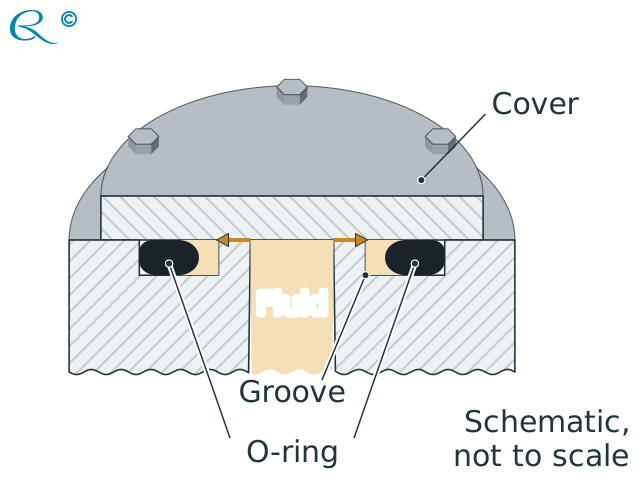
Static Face Seals
The ring sits in a groove in one face and is squeezed by a flat cover or flange: filter housings, covers, pump and valve body joints, split flange heads. Nothing slides, so the widest range of materials can be used. With the pressure inside, the ring should rest against the outer wall of its groove.
Tell us: the groove’s diameters, width and depth if the old ring is lost, and whether the pressure is inside or outside.
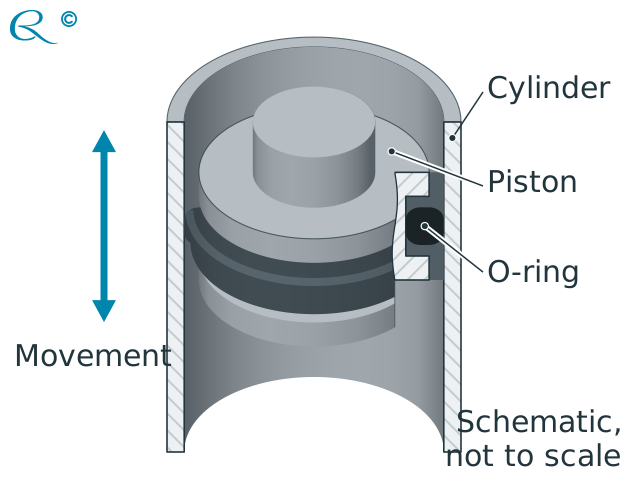
Rod and Piston Seals
The ring sits in a groove on a piston or spool, or in the bore around a rod, and the parts slide past it. A moving seal needs a tough, wear-resistant material and a smooth, lubricated surface; hydraulic cylinders often use purpose-made rod and piston seals rather than plain O-rings.
Tell us: the rod or bore diameter, the groove size, and how far and how often the part moves.
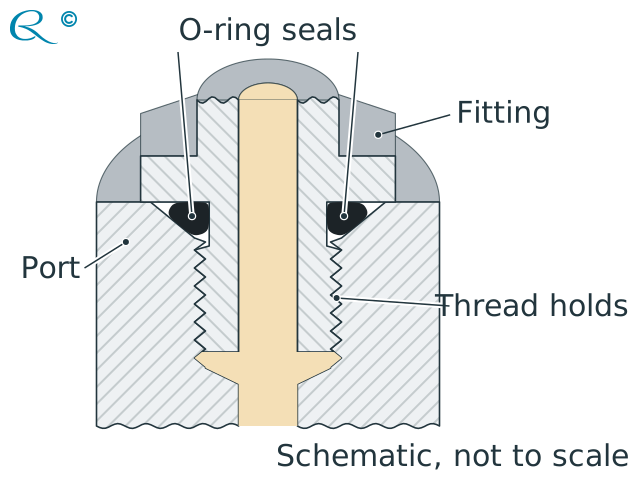
Port and Fitting O-Rings
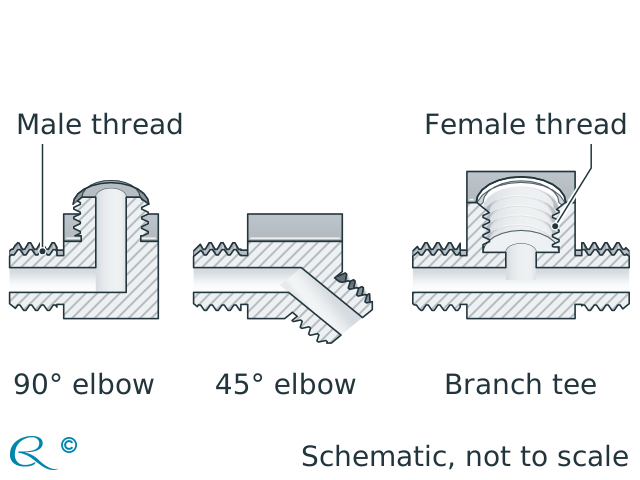
Straight-thread ports and O-ring face seal (ORFS) fittings seal on an O-ring, not on the thread: the ring is pressed into the chamfer at the mouth of the port, or held in a groove in the face of the fitting. The connection’s standard and size set the ring; the thread size alone does not identify it.
Tell us: the thread size and form, such as UNF, metric or BSPP, the port type from your drawing or parts list, and the type of fitting.
Backup Rings
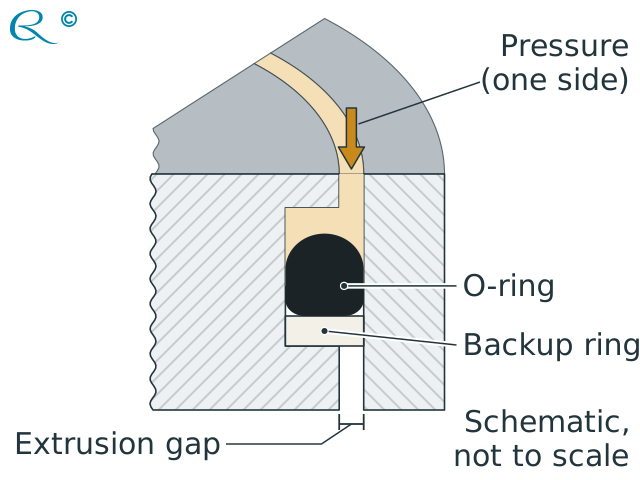
Rings of PTFE or hard plastic fitted beside an O-ring, on the side away from the pressure, so that high pressure or a large gap cannot squeeze the O-ring into the gap between the parts. With pressure from both sides, a backup ring is usually fitted on each side.
Tell us: the groove width, and whether the old seal had one or two backup rings, solid, split or spiral.
O-Ring Materials
Choose the material for the fluid first, then check the temperature. For phosphate ester fire-resistant fluids, the material is checked against the exact fluid.
NBR, FKM, EPDM and Other O-Ring Materials
General guides, not ratings: check the compound. The figures are typical ranges for common grades of each material family, not limits of the rings we supply; the exact compound and the duty set the limits, and special grades reach further.
| Material and a typical range for common grades | Often used for | Common limitations: check the compound |
|---|---|---|
| NBR (nitrile): about -30 to +100 °C | Mineral hydraulic and lube oils, diesel, grease, air, and water at moderate temperatures | Glycol brake fluid, phosphate ester fluids, ozone and weather outdoors |
| HNBR: about -30 to +150 °C | Oils and fuels where NBR runs too hot or wears too fast | Phosphate ester fluids |
| FKM (fluorocarbon rubber): about -20 to +200 °C | Hot oils, fuels and many chemicals | Hot water and steam in common grades, glycol brake fluid, very low temperatures |
| EPDM: about -45 to +130 °C; peroxide-cured grades to about +150 °C | Water, steam, glycol coolants and glycol brake fluid | Mineral oils, fuels and grease, which make it swell |
| Silicone: about -60 to +200 °C | Static seals in air and over wide temperature ranges; food and drink equipment, in compounds approved for food contact | Moving parts, as it tears and wears easily; most fuels |
| PU (polyurethane): up to about +80 °C in common grades; some compounds go higher | Moving hydraulic parts that see wear and high pressure | Hot water and steam, which break down many grades; resistance varies by compound |
O-Ring Sizes
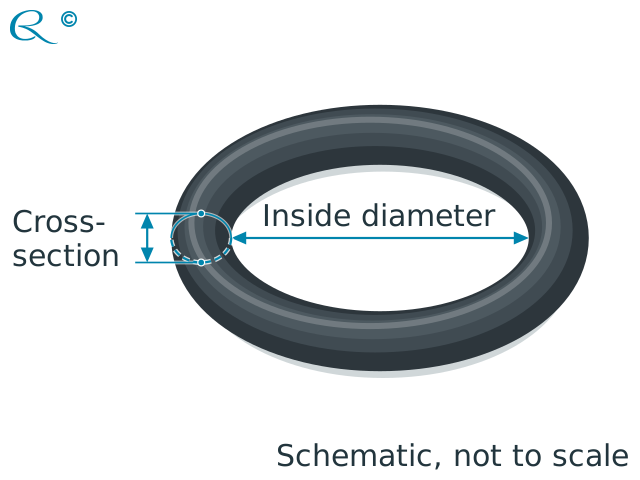
An O-ring is named by its inside diameter and its cross-section, the thickness of the ring; two rings with the same inside diameter can have different cross-sections. Inch rings are usually ordered by an AS568 dash number, which fixes both. Metric rings are ordered by inside diameter x cross-section in mm, such as 20 x 2.5.
Metric series include sizes close to the inch ones, such as a 3.55 mm cross-section beside 3.53 mm. Their nominal sizes and tolerances differ, so a near match is neither automatically interchangeable nor automatically unusable: whether it seals depends on the groove. Give the series and size your drawing or parts list uses.
O-Ring Size Chart: Inch Series Cross-Sections
In each group of the AS568 inch series the cross-section stays the same, and the dash number rises with the inside diameter.
| Dash numbers | Cross-section (inch) | Cross-section (mm) |
|---|---|---|
| -004 to -050 | 0.070 | 1.78 |
| -102 to -178 | 0.103 | 2.62 |
| -201 to -284 | 0.139 | 3.53 |
| -309 to -395 | 0.210 | 5.33 |
| -425 to -475 | 0.275 | 6.99 |
| -901 to -932 | Varies with the port size | Varies |
The -900 group is for straight-thread ports in inch fittings. Send the dash number and we confirm the inside diameter with the quotation.
How to Measure an O-Ring
Lay the ring flat and measure it without stretching it: the inside diameter across the hole, and the cross-section with a calliper closed only lightly on the ring.
For a large ring, measure round its outside with a tape and divide by 3.14 to get the outside diameter; the inside diameter is the outside diameter less twice the cross-section.
An old ring may have shrunk, swollen or taken a flat set. Where you can, measure the groove as well, its diameters, width and depth, and send them with the ring’s figures.
Before We Select an O-Ring
These details let us choose the ring. What our quotation will confirm: the item we propose and its specification, what we matched it to, the quantity and availability.
| Detail | Why it matters |
|---|---|
| The fluid | The ring must not swell, shrink or harden in it: mineral oil swells EPDM, and glycol brake fluid attacks NBR. |
| Maximum and minimum temperatures | Heat hardens rubber and cold stiffens it, so a ring that seals when warm may leak on a cold start. |
| Pressure, and the gap between the parts | High pressure or a large gap needs a harder ring or a backup ring. |
| Static or moving | A moving seal needs a tougher material and a groove made for it. |
| Size: inside diameter and cross-section, dash number, or groove sizes | Measured as described above; a near size is checked against the groove before it is used. |
| Quantity, or the positions for a machine set, and the date | Lets us confirm availability and lead time with the quotation. |
Example
From Our Quotations
We have quoted O-rings with split flanges for a pipeline job, and O-rings and seal rings as oil centrifuge spares.
Questions Buyers Ask
Can you supply a set of O-rings for a whole machine?
Tell us the machine, or send the list of positions and sizes, and we quote a set. A kit of the sizes a machine uses saves hunting for single rings during a breakdown.
When should I use an FKM O-ring?
FKM is the family name for fluorocarbon rubber, which is sold under several trade names. It is the usual choice where NBR would run too hot, or meets fuels and chemicals it cannot take; the materials table gives a typical range for its common grades.
What hardness should an O-ring be?
70 Shore A is the common hardness for general use. A 90 Shore A ring resists being squeezed into a gap at higher pressures, but needs more force to fit and seals less well at low pressure; a backup ring is the other way to stop that squeezing.
Does your invoice show the HSN code?
Yes. Our GST invoice shows the HSN or SAC code for each line.
Do you keep stock?
Availability is confirmed with each quotation.
What is the price?
Prices depend on the material, the size and the quantity, so we quote for each enquiry.
Where We Work
Tamil Nadu
Telangana
Kerala
Andhra Pradesh
Odisha
Delhi NCR
Rajasthan
Jharkhand
Uttar Pradesh
West Bengal
Punjab
Chhattisgarh
Send Your O-Ring Details
Inside diameter, cross-section, material or fluid, and quantity.
Request received. Your reference is {ref}. We reply during office hours, Monday to Saturday, 9.00 am to 5.30 pm. For a breakdown or a plant shutdown, call +91 99400 49505 at any time. Nothing is booked or ordered until we confirm scope, availability and terms in writing.Prefer to talk? Call +91 99400 49505 or WhatsApp us.
Related
Hydraulic Fittings
Hose ends, tube fittings and adaptors, matched to your thread form and size.
Flanges
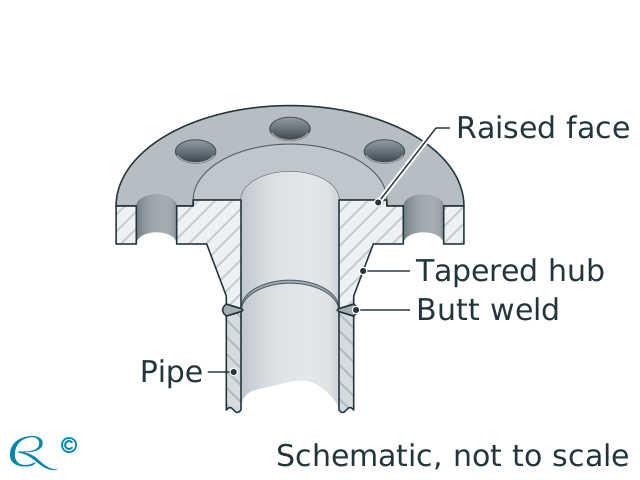
Pipe flanges, and four-bolt split flanges that seal with an O-ring.
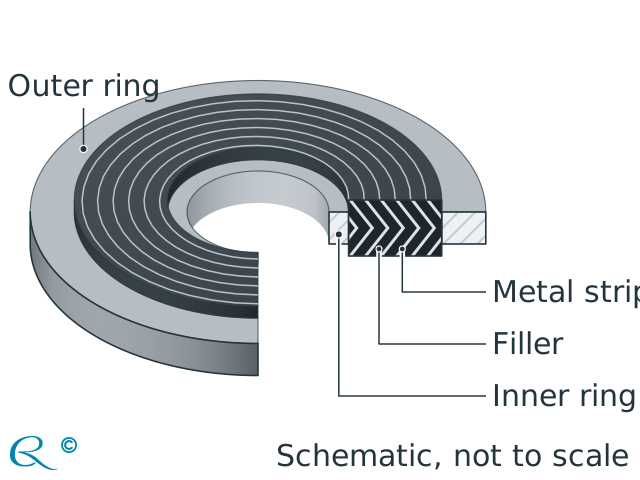
Gaskets
Spiral wound, ring joint and sheet gaskets for each flange face.
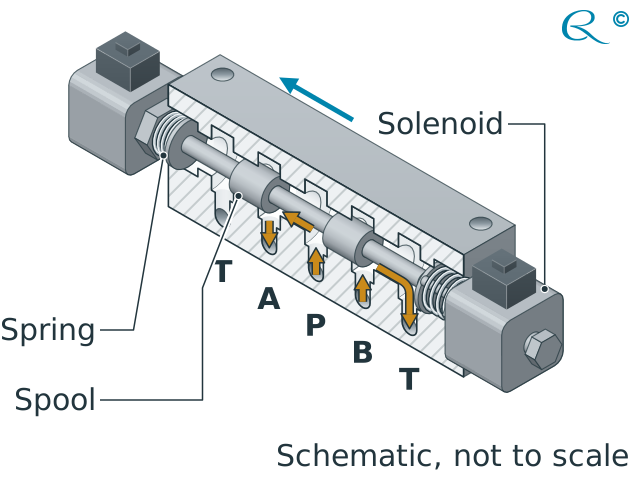
Valves
Hydraulic directional, relief, flow control and check valves, and ball valves for oil and fuel lines.
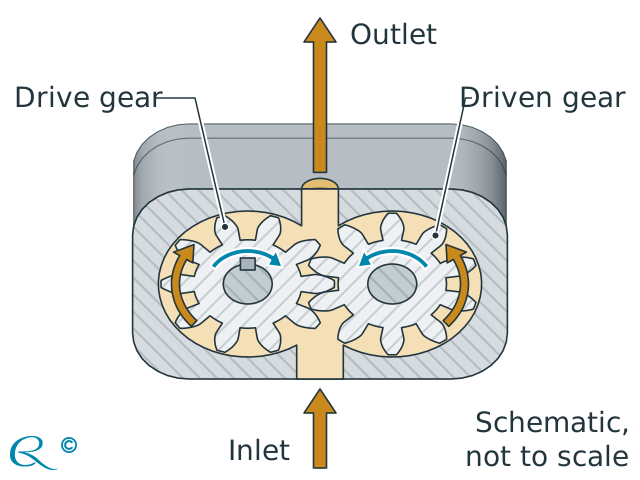
Hydraulic Pumps
Gear, vane and piston pumps, and transfer pumps for oil and diesel.
Hydraulic Oil Filtration
Clean oil wears seals less: the oil in your power packs and presses filtered at your site with our machines.